Etapa 1 – Pre-Reading Stage (Etapa Prelectora)- STEP 1

Teaching Beginning Sounds

When children are first learning to read, one of the foundational skills they develop is recognizing sounds. Teaching beginning sounds to 3- and 4-year-olds can be a joyful and interactive process that lays the groundwork for lifelong literacy. In this blog post, we’ll explore effective strategies, playful activities, and helpful tips to make learning these concepts fun and memorable.

Why is Phonemic Awareness so Important

Before children can read words, they must understand that words are made up of individual sounds. Phonemic awareness—the ability to hear, identify, and manipulate these sounds—is a critical pre-reading skill. By teaching beginning sounds:

You help children develop the ability to match letters with sounds.
You build the foundation for blending sounds to form words.
You foster a love for language and reading.

Start with Letter Sounds, Not Names

While letter names are important, focusing first on the sounds letters make helps children decode words more effectively. For example, instead of teaching “B” as “be” introduce it as the /b/ sound. This approach builds a direct connection between letters and their sounds, making reading easier down the road.

How to Teach Beginning Sounds

Order of Letters

In the Spanish language, it is imperative to start with the vocales (A-E-I-O-U) After these letters have been explicitly taught, then we move on to the consonantes.

Below you will see the specific order in which each letter is taught. How many letters per week will really depend on your child. Some families do a single letter per week, while others do a new letter each day. Each child is different, and this can be modified for their needs.

SetsLetters
Set 1O, A, I, U, E
Set 2 M, P, S, L
Set 3 T, D, R, C, C
Set 4N, F, B, J
Set 5G, G, CH, Ñ, V, Ll
Set 6Q, Z, H, Y, X
Set 7K, W

Teaching the Target Sound

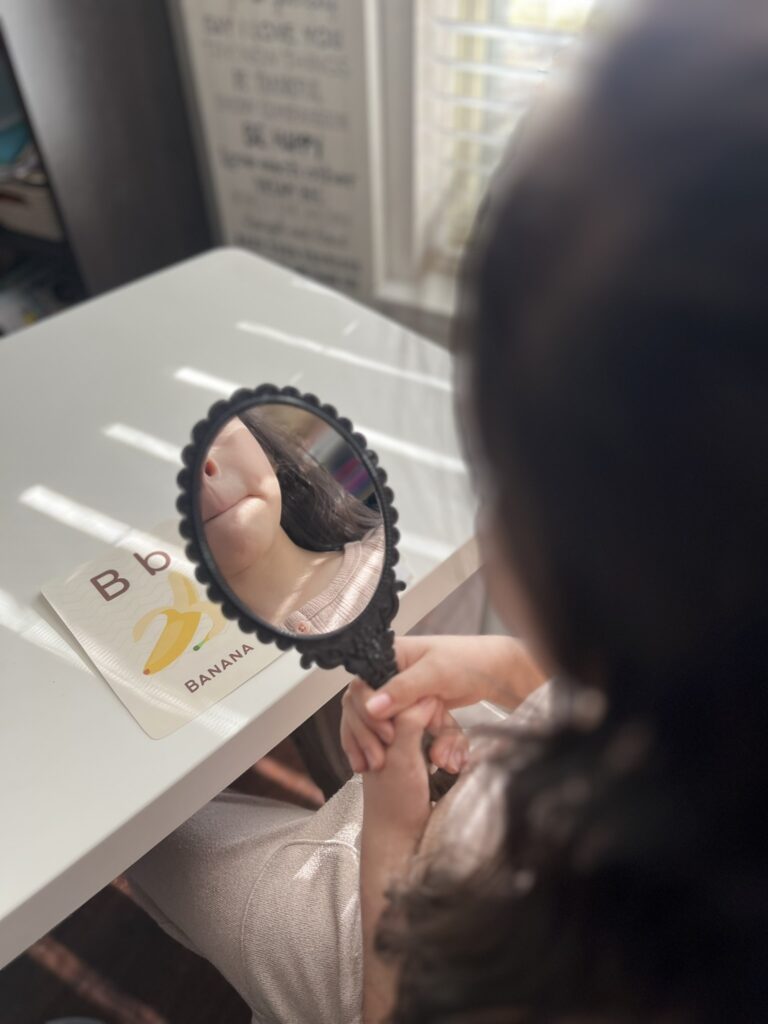
When teaching sounds, mouth placement is critical for kids to see be modeled and practice. Exaggeration is key for children to start hearing the correct sound and to have correct mouth, tongue and teeth placement when practicing these sounds. This is how I begin:
Introduce Target Sound – A simple introduction such as, “Hoy aprenderemos sobre el sonido /a/”.
Explain and Demonstrate Mouth Movements – “Cuando hago el sonido /a/, abro mi boca, relajo la lengua y hago el sonido. Mira como yo lo hago”
Use the Mirror Strategy – Invite students to use a mirror. “Ahora tu turno. Toma ese espejo y practica el sonido conmigo”

Connect to World

Connecting old information to new information is a great way for children to anchor new knowledge. Gathering objects or using picture cards of objects that begin with target letter sound is important for memory retention, engagement and connections.

Connect Target Sound to Anchor Object – Your anchor object will be that to which you will constantly refer to when referring to target sound. “La /a/ de animal”
Provide Additional Objects with Target Sound – “Otras cosas que empiezan con la /a/ son, Avion, Angel, ect.”
Use Picture Cards to Reinforce Target Sound – Our picture cards contain some images that are cognates in English and Spanish. Meaning that they are words that are related. (Astronauta – Astronaut) These are a great tool for bilingual students.

Engaging Activities

One of my favorite activities that I do with my toddler when introducing a new letter sound is “House Scavenger Hunt“.

We look for items around the house that begin with our target letter sound. We then bring them together, say their name and reiterate the beginning sound of each item. This is so fun, engaging and allows the child to have agency over their learning.

Helpful Tips for Success

  • Be Patient and Encouraging Every child learns at their own pace. Celebrate small successes and encourage continued exploration.
  • Keep Sessions Short and Engaging Young children have short attention spans. Aim for short, interactive sessions of 10–15 minutes.
  • Incorporate Movement Incorporate actions and body movements to keep children actively engaged. For example, make animal sounds and movements while learning about different sounds.
  • Use Technology Wisely Educational apps and videos can supplement learning but should not replace hands-on activities.

I use this method when teaching any letter, be it a vowel or a consonant. Even if your child has been exposed to letters, knows their ABC’s, it is still extremely important that you teach explicitly each letter to build a solid foundation in Spanish Literacy. Read our next post on how to Connect Sounds to Letters!

For Visual Learners, Watch our Video!

Visit our Shop for Materials

Scroll to Top